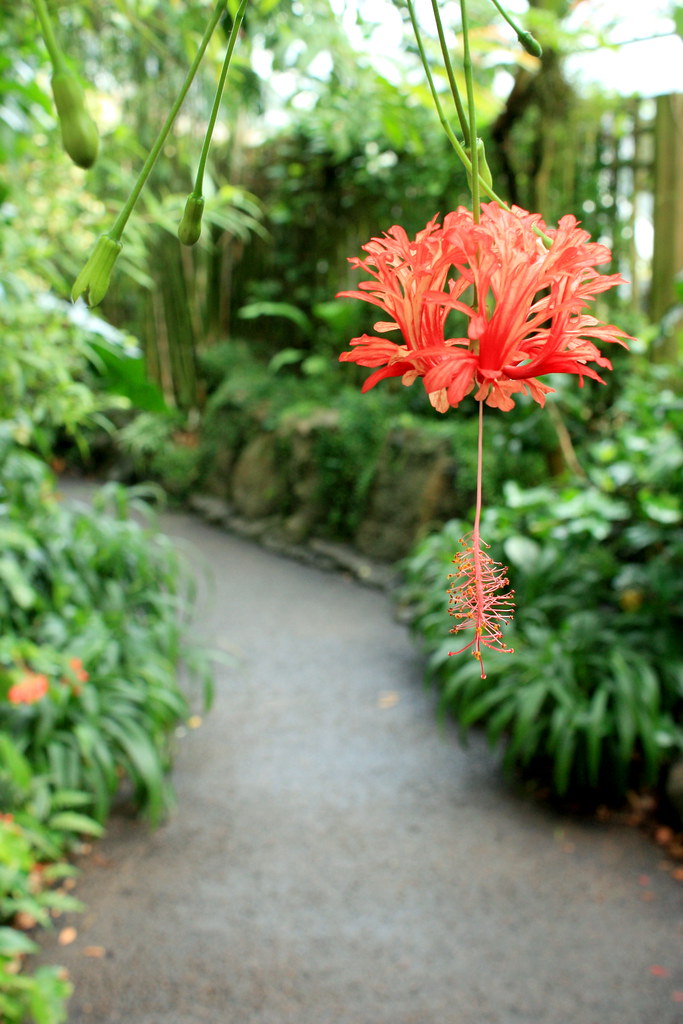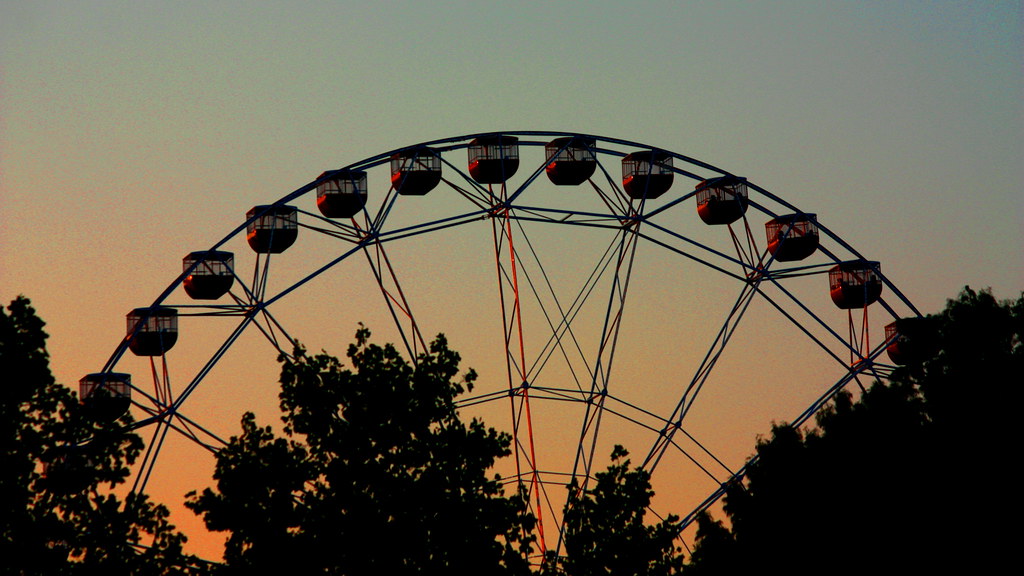
Where in St. Louis am I?
Yes, last week's shot was of the geodesic dome in Missouri's Botanical Gardens. Named "The Climatron," it is the first geodesic dome to be used as a conservatory. A geodesic dome is a spherical, or partially spherical, shell based on a network of great circles. The geodesics intersect to form triangular, sometimes hexagonal or octagonal, elements which distribute the stress of the structure in a more balanced fashion. Perhaps, the most famous geodesic dome is Spaceship Earth in Disney World's Epcot Center. A conservatory is a large, glass greenhouse. The Climatron has no interior support and no columns from floor to ceiling. It rises 70 feet, has 1.3 million cubic feet of volume, and encloses over 24,000 square feet (more than half an acre).
Controlling a tropical rainforest's theme, The Climatron's temperatures range from 64F to 85F with an average humidity of 85%. It houses more than 2,800 plants and more than 1,400 individual species. Several species of birds also call The Climatron home.
While I continue to try and take a worthy picture of the structure itself, here are a couple shots I'm proud of that you can find when you go inside...
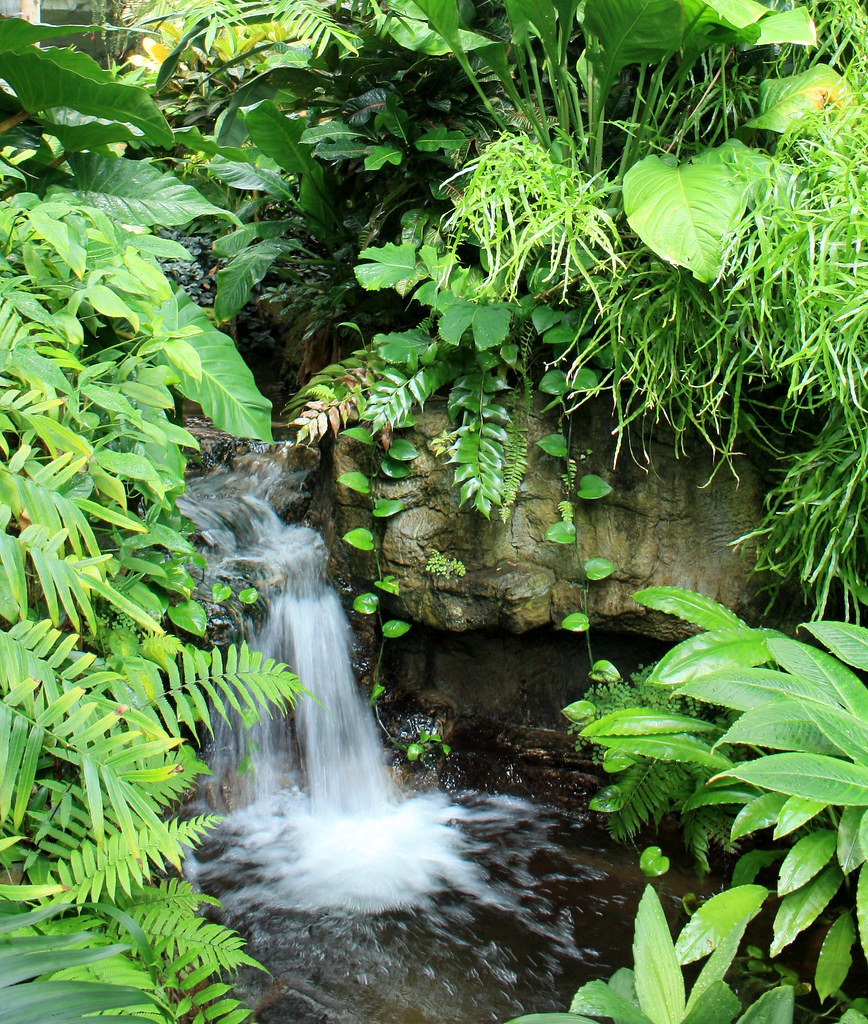
Enjoy your Monday. Again, where is the picture at the top from?
A photographic, historical tour of St. Louis, Missouri with the occasional jaunt into the woods.
Showing posts with label Missouri Botanical Gardens. Show all posts
28 November 2011
15 November 2011
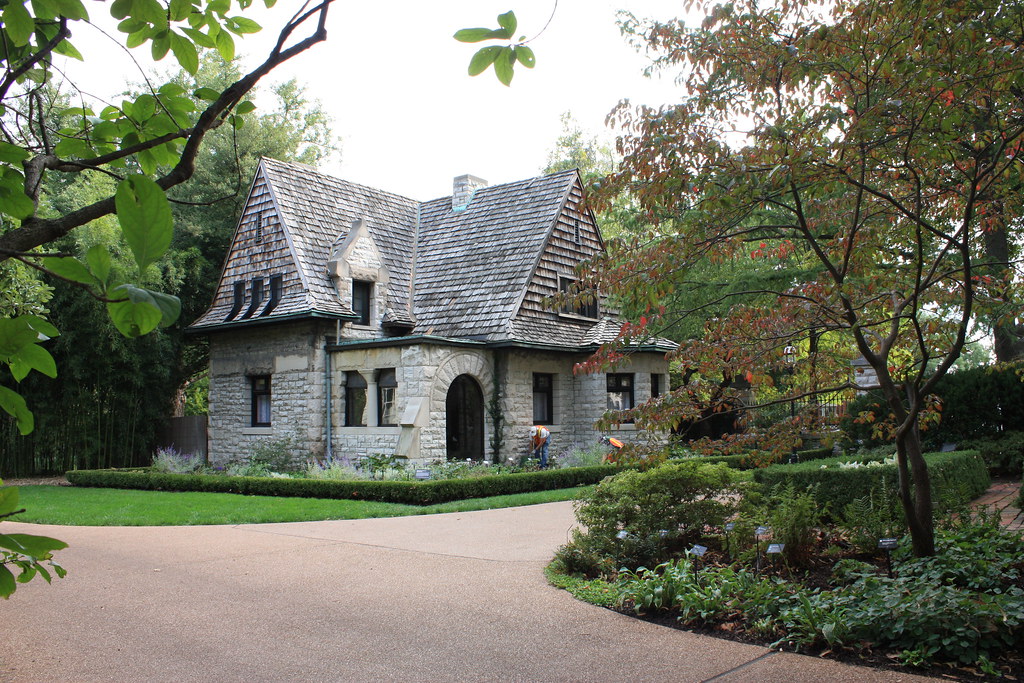
The Cleveland Gatehouse..
This secluded house within Missouri Botanical Gardens in St. Louis, Missouri is located near Henry Shaw's "Tower Grove House" and his research library. The structure was named the Cleveland Gatehouse.
Gatehouses used to be heavily depended upon structures used to strategically defend castles in medieval times. Often they were used in conjunction with drawbridges and murder holes. However, once technologically less important, they became symbols of opulence and were used to house other things of less importance. In this case, the Cleveland Gatehouse was built for the groundskeeper as a home. It was also the last building Henry Shaw commissioned before his death. Ironically, Shaw's will stipulated that the groundskeepers live in his home, Tower Grove House, after he passed. So, only a few, if only one, groundskeepers actually resided here.
I haven't been able to find much detail on this building, or it's purpose, and it currently remains closed to the public. However, if you look closely when visiting the gardens, you may agree with me that it is one of the more underrated beauties in terms of it's architectural detail. The house was built in 1895 and has combined Gothic revival details combined with extensive shingles used in a pleasing harmony.
25 October 2011
Temperate Courtyard
I definitely need to get out and shoot again soon. Been swamped with work as leaves begin to fall.
This area of Missouri Botanical Gardens is climate controlled to mimic the environments of the Mediterranean, Southern California, Central Chile, etc, around the world. Cool, moist winters and warm, dry summers are the main weather features of these areas of the world. Temperatures rarely drop below 40 degrees, and rarely rise above 90 degrees. Heck, I ought to move in and set up camp. Can't go wrong with that kind of weather, huh?
23 October 2011
Water Lily..
The more I learn to shoot flowers, the more I love water lillies. They are so simple. And, I'm finding I am more of a "minimalist" photographer. Sure, I love sports and action shots, but ultra-simple photography really appeals to me for some reason.
This lily was sitting in front of The Climatron in the reflecting pools. There are also water lillies in Tower Grove Park, Compton Hill Resevoir (click link for former blog link with location and map), Forest Park, and other places around the city. (Image shot at f/7.1 @ 1/1000th)
22 October 2011
Ottoman Flower..
I was fascinated by the water droplets still on the petals here. I have tried to capture this type of thing before without much luck. These flowers were very pretty even though they were only about 6-8 inches high. I probably looked like an idiot lying down in the dirt to get the angle, but I didn't much care about what others thought. I wish I could have avoided the greenery on the left cutting into the flower, but this was by far the prettiest flower in the bunch. Oh well. (Image shot at f/5.6 @ 1/640th)
21 October 2011
The Ottomans Represented..
Back to Missouri Botanical Gardens for a bit. This Ottoman Garden was pretty neat. Central water feature, throne area in the back under the pergola/arbor, and lots of great plantings surrounding the walkways.
This is an interestingly simple garden for St. Louis to pull off because our latitude is almost the same with Turkey (40 degrees north). The garden is modeled after 16th to 19th century Turkish gardens. This Ottoman Garden is the first of it's kind anywhere in the United States.
15 October 2011
My Little Buddy..
Walking around the Missouri Botanical Gardens and this little wren popped out of the weeds to greet me. I couldn't resist taking some pictures of him as he flitted about looking for insects in the pond.
She looks like a Marsh Wren to me, a bird I've never seen in real life. However, when posted on a photo forum I frequent, some of the experienced birders told me she was another kind of wren I'd never heard of before. I can't remember the name, but they said it was a pretty rare species.
14 October 2011
Back to Missouri Botanical..
If you remember back to the View from the Observatory post, you remember there were some Victorian Gardens near Henry Shaw's Tower Grove House. This is a sample of what you will find. Although, this curved design was at the base of the observatory, it's very similar to what you will find in the Victorian Gardens nearer the house. The lighting was pretty poor over that way since the sun was shining directly on some bright flowers...making proper exposure difficult at best. Enjoy this well-manicured design. In the Missouri Botancial Gardens, perfect gardens like this are all around you. What a place to visit!
06 October 2011
Linnean House at Missouri Botanical Gardens
The Linnean House in St. Louis, Missouri is the oldest continuously operating greenhouse west of the Mississippi River. It is also the only remaining greenhouse in the Missouri Botanical Garden property built during Henry Shaw's lifetime. The Linnean House was built in 1882; Shaw, the garden's founder, died in 1890.
The greenhouse was originally built to overwinter citrus trees and bushes, but today houses many subtropical cacti and camellias. Camellias steal the show in late winter with their blooms, and several of these plants in the Linnean House date back to the 1930s and 1940s.
The greenhouse was named in honor of Carl Linnaeus, the father of modern nomenclature or "the father of taxonomy." The Linnean House has been through several renovations before arriving full-circle at it's original design and purpose. The house has also endured a major hailstorm in 1927, which spurred one of the renovations.
This photo is done with an almost HDR processing "look" to overcome the horrible skies with which I had to deal last week. I like how it turned out. Please comment with your opinion, too, as I may dabble a bit more with this technique in the future.
The greenhouse was originally built to overwinter citrus trees and bushes, but today houses many subtropical cacti and camellias. Camellias steal the show in late winter with their blooms, and several of these plants in the Linnean House date back to the 1930s and 1940s.
The greenhouse was named in honor of Carl Linnaeus, the father of modern nomenclature or "the father of taxonomy." The Linnean House has been through several renovations before arriving full-circle at it's original design and purpose. The house has also endured a major hailstorm in 1927, which spurred one of the renovations.
This photo is done with an almost HDR processing "look" to overcome the horrible skies with which I had to deal last week. I like how it turned out. Please comment with your opinion, too, as I may dabble a bit more with this technique in the future.
05 October 2011
Shaw's Roses
A couple of pictures from Missouri Botanical Gardens. A walk from Tower Grove House to the Climatron will yield a stroll for rose lovers. Stop and smell them. It is said roses can calm anxiety like lavendar and echinacea.
04 October 2011
Let's Take a Walk..
Let's meander around the Missouri Botanical Gardens in St. Louis, MO, shall we? I ran out there last week. I try and get out there once per season to see all the beautiful plants evolve through the seasons.
For today, let me give you the view from atop the observatory near Tower Grove House..
Henry Shaw lived in this "country home" on the left as he built his gardens. The building on the right is the research library. You can also see the Victorian Garden between the house and library. The garden was opened to the public in 1859 at no charge. Several years later, Shaw had this observatory built for the public to offer a better view of the land. Apparetly, Shaw grew tired of the patrons' requests to climb the tower in HIS house to view the gardens from several stories up. Can't say I blame him, either.
For today, let me give you the view from atop the observatory near Tower Grove House..
Henry Shaw lived in this "country home" on the left as he built his gardens. The building on the right is the research library. You can also see the Victorian Garden between the house and library. The garden was opened to the public in 1859 at no charge. Several years later, Shaw had this observatory built for the public to offer a better view of the land. Apparetly, Shaw grew tired of the patrons' requests to climb the tower in HIS house to view the gardens from several stories up. Can't say I blame him, either.
20 September 2011
Compton Hill Water Tower
Before modern electrical production methods, steam-driven pumps were used to send water throughout the city. The steam was powered in a 22 mile loop around downtown St. Louis originating in the Ashley Power Plant at the edge of the Mississippi River just north of Laclede's Landing. The steam often caused large surges in pressure, often causing pipes to rattle and shake. This pressure also caused multi-story buildings to have low, or no, water pressure in the higher floors. These standpipes were erected to equalize the water pressure. For aestetic purposes, towers were built to hide these standpipes.
At the peak of their use, nearly 500 of these towers dotted cities across the USA. Most were torn down as their usefullness became outdated. As of this writing, only 7 remain....three of which are in St. Louis, MO. And, each has been listed on the National Register of Historic Places since the early 1970s. The Grand, The Bissel, and the Compton Hill Water Towers were built in respective order.
Yesterday, I drove to the base of the Compton Hill Water Tower, the city's "newest." It was built in 1898 and stands 179 feet tall. The cost, then, was $48,000. The tower was taken out of service in 1929. Up to 1984, you could climb a spiral staircase inside to the top and grab a 360 degree view of the city of St. Louis. This standpipe was part of the equalization of water pressure process, but it was also necessary because of the Compton Hill Resevoir located very near the standpipe's location.
The Compton Hill Resevoir was built to provide an adequate supply of water to Tower Grove Park. This park was built and donated by Henry Shaw, one of the city's most influential millionaires of the 19th century. Like other areas of the city, follow this blog for long and you will learn about Tower Grove Park and Missouri Botanical Gardens, both Shaw creations.
In 1995, a project was started to renovate the tower and surrounding park. The renovation was completed in 1999. Occasionally, the tower is opened during neighborhood house tours so visitors can take in the views. For scheduled tours, visit the Water Tower and Park Preservation Society's Calendar (calendar).
The above photo was taken from a puddle reflection in the resevoir area. For further information check the Compton Heights Neighborhood page.
Subscribe to:
Posts (Atom)