A photographic, historical tour of St. Louis, Missouri with the occasional jaunt into the woods.
Showing posts with label gateway arch. Show all posts
07 October 2011
Picking pumpkins just across the river in Millstadt, Illinois. Eckert's is a local supplier of apples, peaches, pumpkins, and other miscellaneous produce. The farm allows people to come and pick the fruits and vegetables when they are in season. The three people on the right are my kids and wife, minus a boy not pictured. The two on the left are neighbors (literally, just up the street) we coincidentally ran into at the farm....a half hour's drive from our houses. And, you can see the St. Louis skyline in the background on a gorgeous fall day.
27 September 2011
St Louis Gateway Arch
The Gateway Arch was built as a memorial to the westward expansion of the United States. Thomas Jefferson's vision was to expand freedom and democracy from "sea to shining sea." The Arch currently stands as the tallest national monument.
A brief history on downtown St. Louis: The original village of St. Louis was contained within the present limits of downtown along the riverfront. It was on the site of the present Jefferson National Expansion Memorial (The Gateway Arch being the centerpiece). The location was chosen by Pierre Laclede, the City's founder, because it met his requirements for a fur trading post site that was not subject to flooding and was near the confluence of the Mississippi and Missouri Rivers. By 1766, St. Louis had a population of about 300 people and 75 buildings. Four years later it reached 500 people and had grown so that the Rue des Granges, now Third Street was built up. With the gradual change of the area from residential to commercial, the location of the City's finer residences and churches moved west of Twelfth Street after 1850 when Lucas Place became the fashionable residential street. During the 1870's the center for such elegant living moved westward again toward Grand Avenue. Soon after, the most expensive and fashionable homes crossed Grand Avenue following the development of Vandeventer Place. The city of St. Louis has never looked back as it's expansion through the years kept moving westward.
Only since the late 20th century, has there been intense interest to revitalize the areas of St. Louis that have been left behind by the local "westward expansion."
A brief history on downtown St. Louis: The original village of St. Louis was contained within the present limits of downtown along the riverfront. It was on the site of the present Jefferson National Expansion Memorial (The Gateway Arch being the centerpiece). The location was chosen by Pierre Laclede, the City's founder, because it met his requirements for a fur trading post site that was not subject to flooding and was near the confluence of the Mississippi and Missouri Rivers. By 1766, St. Louis had a population of about 300 people and 75 buildings. Four years later it reached 500 people and had grown so that the Rue des Granges, now Third Street was built up. With the gradual change of the area from residential to commercial, the location of the City's finer residences and churches moved west of Twelfth Street after 1850 when Lucas Place became the fashionable residential street. During the 1870's the center for such elegant living moved westward again toward Grand Avenue. Soon after, the most expensive and fashionable homes crossed Grand Avenue following the development of Vandeventer Place. The city of St. Louis has never looked back as it's expansion through the years kept moving westward.
Only since the late 20th century, has there been intense interest to revitalize the areas of St. Louis that have been left behind by the local "westward expansion."
19 September 2011
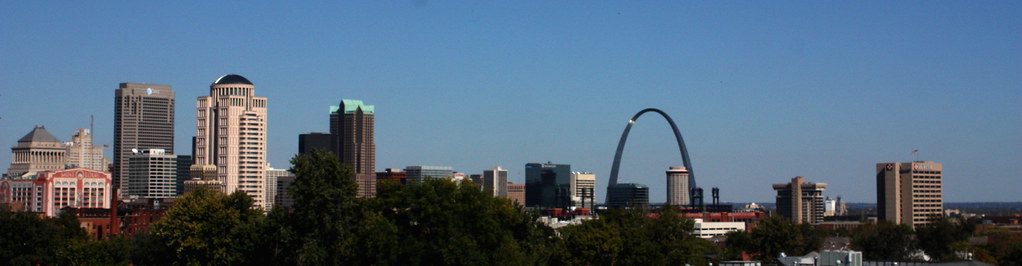
St. Louis Skyline
One of my favorite views of the St. Louis skyline. Taken atop one of the "painted ladies" in Lafayette Square, a St. Louis neighborhood dating back into the 1800s (one caveat to the blog will be the historical tours I plan to give you of St. Louis' historic neighborhoods). I met a gentleman while walking around Lafayette Park. We talked awhile and he offered the view from his roof. I'm not normally this "risque" when it comes to strangers, but I'm glad I trusted this man. The view was spectacular, and an adventure I won't forget.
Click to enlarge the "panoramic" view that is really just a panoramic crop. (Image taken at ISO400, f/11, 1/1600th with my 18-55mm lens)
Subscribe to:
Posts (Atom)